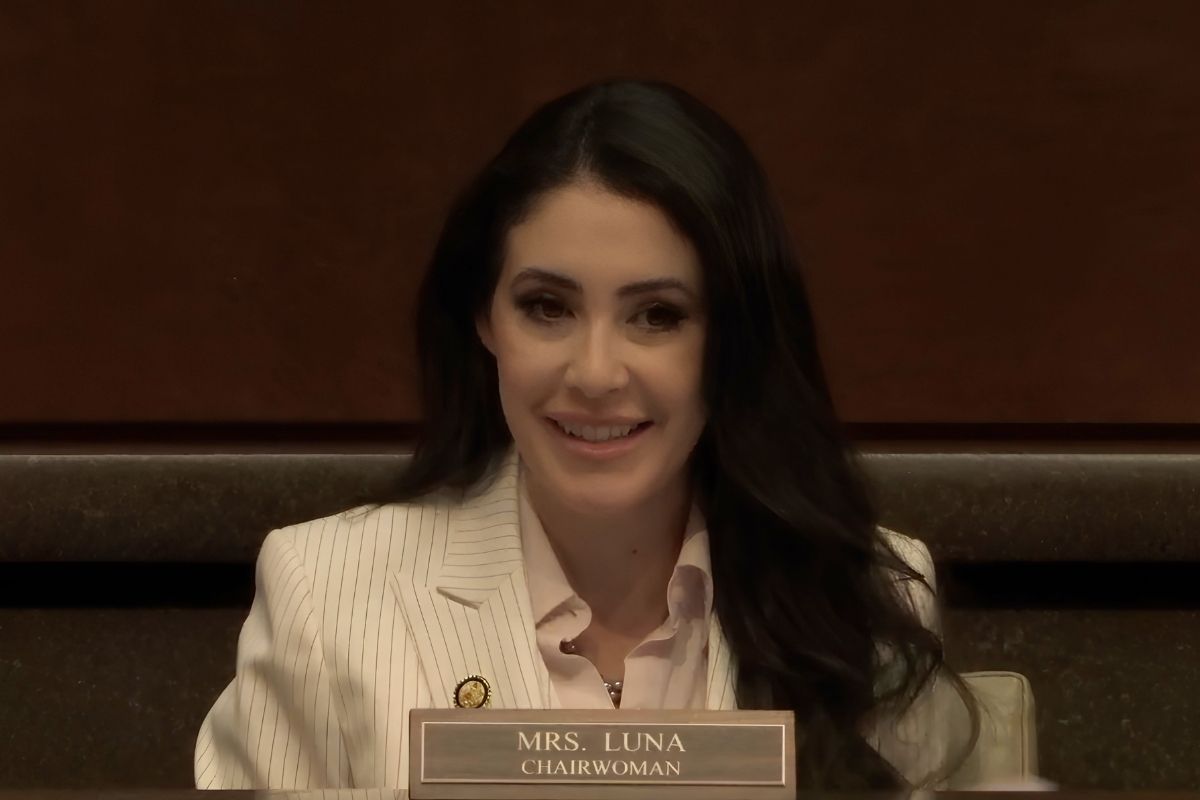
American history’s darkest part from decades ago is about to come back to Capitol Hill. On April 29, 2026, Florida GOP Rep. Anna Paulina Luna said that on May 13, the House Oversight Task Force would hold an official hearing on MK Ultra. It started a new debate about one of the CIA’s most controversial secret projects and made people wonder what else the U.S. government still hasn’t told the public.
Who Is Anna Paulina Luna?
The head of the House Oversight Task Force on the Declassification of Federal Secrets is Rep. Anna Paulina Luna (R-FL). As part of its work, the task force has been pushing the federal government to be open about a number of sensitive historical issues. For example, it wants records about the murder of Dr. Martin Luther King Jr. should be made declassified. This is according to the policy of President Donald Trump in his executive order, which instructs federal agencies to declassify large amounts of information in order to bring back the public’s trust in the government.
“A Declassified CIA Files Show Alarming Plan To Mind Control America Through Secret Drugging With Vaccines,” is the article that Luna found relating to MK Ultra. “I think that our next task force hearing will be on MK Ultra,” Luna commented. There will be a scheduled hearing on May 13 regarding the above signal.
What Was MK Ultra?
In MK Ultra, the U.S. Central Intelligence Agency conducted illegal experiments on people in order to come up with ways to change people’s behavior and find drugs that could do that. The program ran from 1953 to 1973 and then stopped. It used many tricks to change the minds and brains of its subjects, such as giving them large amounts of psychoactive drugs, mostly LSD, and other chemicals without their knowledge or permission.
MK Ultra was a covert umbrella project that ultimately funded 149 sub-projects. Its primary phase involved the use of federal institutions, hospitals, pharmaceutical companies, and specialists with the intent of finding new substances for the CIA’s brainwashing aspirations. In the second phase, which started in 1955, drugs were given to U.S. citizens who didn’t know they were getting them, sometimes through an unofficial deal with the Bureau of Narcotics.
The program reached people outside of the U.S. By hiring Scottish psychiatrist Donald Ewen Cameron, who came up with the idea of “psychic driving” and wanted to cure schizophrenia by wiping out memories and reprogramming the mind, the CIA sent trials to Canada.
The Korean War Connection: Newly Confirmed
Perhaps the most significant new revelation driving the congressional interest comes from recently released documents. Declassified documents show for the first time that the CIA used North Korean prisoners of war in experiments while they were in U.S. custody. Between December 2024 and April 2025, the National Security Archive released these papers in a collection called “CIA and the Behavioral Sciences: Mind Control, Drug Experiments and MK-ULTRA.” The set includes over 1,200 records relating to one of the most infamous and abusive programs in CIA history, according to the National Security Archive.
As these recently declassified documents show, North Korean prisoners held captive by the United States were experimented on as part of Project Bluebird in October 1950. Project Bluebird was an early version of MK-ULTRA, and its goal was to “control a person to the point where he will do our bidding against his will and even against such basic laws of nature as self-preservation.”
The Cover-Up: Destroyed Files and Senate Investigations
The full picture of MK Ultra has always been incomplete by design. In 1973, Richard Helms, the head of the CIA, ordered the destruction of all documents relating to MK Ultra. The Church Committee and Rockefeller Commission later investigated what occurred on the basis of depositions from individuals who had direct knowledge of events and surviving documentation after Helms’ directive. A Freedom of Information Act request in 1977 found a stash of 20,000 papers about MK Ultra. This led to hearings in the Senate.
On August 3, 1977, CIA Director Stansfield Turner admitted that MK Ultra existed and told a joint session of the Senate Select Committee on Intelligence that he was “horrified” by the secret drugging of citizens and that the agency would try to find out who the subjects were and think about what the government should do for them.
The case of Frank Olson, who was a biochemist working for the US Army, forms some of the most horrific moments of the TV program. On November 28, 1953, Frank Olson passed away after jumping through the 10th-floor window of the Statler Hilton Hotel in New York City. At first, it was thought that he had killed himself. It turned out that Olson had been given LSD through a drink without realizing it. When details of his death were made public, so was the CIA’s top-secret MK Ultra program.
The Broader Declassification Push
Luna’s MK Ultra hearing fits into a wider political moment. The Trump administration’s push to declassify sensitive government records — spanning the JFK assassination, MLK assassination, Epstein files, and now MK Ultra — has given congressional figures like Luna a platform to revisit Cold War-era abuses. The documentary trail remains explicitly incomplete, as MK Ultra files were deliberately destroyed in 1973 by program managers — an action the agency itself acknowledged and congressional investigators cited as a major obstruction.
The legacy of MK Ultra goes far beyond the different sub-projects that are talked about in papers that have been preserved. Scholars say that to figure out what happened, researchers today use declassified FOIA releases, preserved records, committee transcripts, and carefully chosen digital collections to cross-reference each other.
Why It Still Matters
The upcoming hearing will likely press current and former intelligence officials on what additional records exist, whether any victims or their families have been compensated, and whether the experimental ethos of MK Ultra had successor programs. The questions are not merely historical — they go to the heart of how much unchecked power intelligence agencies can wield over citizens without consent or accountability.
Luna’s task force has been methodically building a case for government transparency, and MK Ultra may be its most explosive subject yet.
Sources:
- The National Desk — Luna MK Ultra Hearing Announcement
- House Oversight Committee — Luna MLK Hearing & Task Force Background
- Wikipedia — MK Ultra Overview
- The Intercept — CIA MK Ultra Experiments on POWs Confirmed
- National Security Archive — CIA Behavior Control Experiments Collection
- Princeton Special Collections — MK Ultra History
- U.S. Senate Intelligence Committee — MK Ultra 1977 Hearing Documents