Before a customer reads your tagline, before they hear your pitch, before they even pick your product up off the shelf — your packaging has already spoken.
It said something about your price point. It hinted at your values. It either earned a second glance or didn’t. All in under two seconds, without a single word exchanged.
That’s the quiet power of product packaging design — and most businesses don’t think about it nearly enough.
The Shelf Is a Conversation
Walk down any supermarket aisle and you’re essentially walking through a room full of strangers all trying to get your attention at once. Each product is making a case for itself purely through shape, colour, material, and type. No context. No explanation. Just visual instinct is doing all the work.
What’s fascinating is how quickly our brains make decisions in that environment. Research in consumer behaviour consistently shows that purchasing decisions happen largely in the subconscious — triggered by visual cues long before rational thought kicks in. A box that feels premium gets treated as premium. A label that looks rushed gets passed over, even if the product inside is excellent.
This is why packaging isn’t just a container. It’s a salesperson who never sleeps, never has an off day, and never misses a shift.
The “It’s Just a Box” Mistake
There’s a surprisingly common belief among small and growing businesses that packaging is purely functional — something to protect the product and display the legally required information. Get it done cheaply, get it done fast, move on.
The problem with this thinking is that it ignores what packaging design actually does in the real world.
Consider two identical candles: same scent, same burn time, same wax quality. One comes in a plain white box with a printed sticker. The other arrives in a matte black box with foil lettering and a ribbon pull. They cost the same to make. But ask anyone which one they’d rather receive as a gift — or which one they’d pay more for — and the answer is almost always the same.
Packaging design changes the perceived value of what’s inside. It’s not about being dishonest about your product; it’s about doing justice to it. When you’ve put genuine effort into what you’re selling, your packaging should reflect that.
When Packaging Becomes the Product
Some of the most talked-about brands in the world have turned their packaging into an experience in itself.
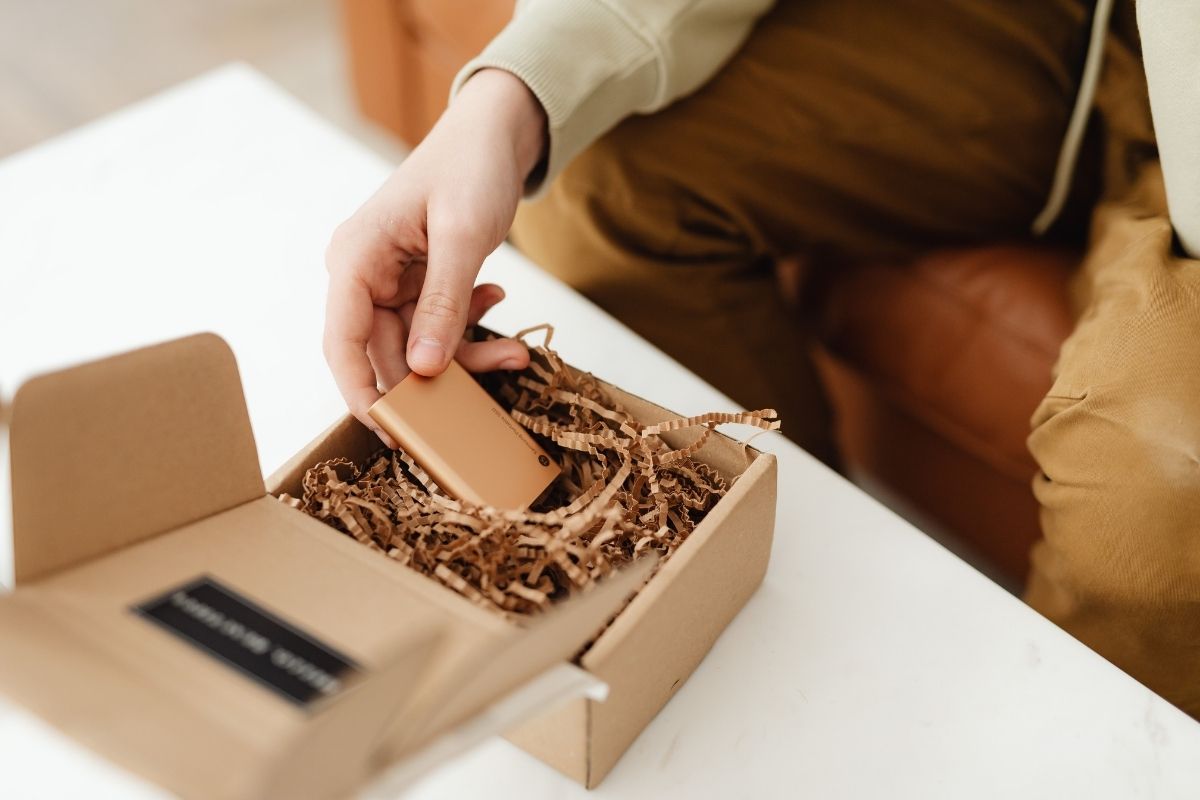
Think about the ritual of opening a new phone — the slow, satisfying lift of the lid, the perfectly fitted foam, the deliberate order in which each component is revealed. That experience was designed. Every millimetre of it was considered. And it works — people film themselves opening boxes and post the videos online. The packaging became content.
Or consider the small food brands that use kraft paper, hand-stamped labels, and twine not because it’s cheaper (it isn’t), but because it tells a story about craft, locality, and care. The packaging communicates what a paragraph of marketing copy couldn’t.
This is what happens when packaging stops being an afterthought and starts being part of the product itself. The unboxing moment becomes a memory. And memories are what make people come back.
Colour Does More Work Than You Think
Colour psychology in packaging design is one of those topics that sounds a little abstract until you start noticing how deliberate it is everywhere around you.
Green signals natural, fresh, ethical — which is why you’ll find it dominating health food, organic produce, and eco-conscious brands. Black communicates luxury, sophistication, and premium positioning. Yellow triggers energy and appetite (no accident that fast food brands love it). Soft pastels whisper self-care, calm, and femininity. Bold primary colours shout fun, accessibility, and youth.
None of this is accidental. Colour choices in packaging are strategic, and getting them wrong can actively undermine a product — putting a premium item in budget-looking colours, or making a children’s product look clinical and cold.
The best packaging design uses colour to reinforce what the product already is, rather than trying to say something the product can’t back up.
Typography: The Detail Most People Overlook
If colour is the mood, typography is the voice.
A serif font on a wine label speaks to tradition, craftsmanship, and age. A clean sans-serif on a tech product says modern, minimal, precise. A loose, hand-drawn script on a jam jar says homemade, personal, lovingly made by someone’s grandmother.
The mistake many brands make is choosing a font they like rather than a font that fits. What looks great on a mood board doesn’t always translate to a printed label at 40mm wide. Type on packaging has to work at size, from a distance, and often in a split second of attention.
Hierarchy matters too — the product name, the variant, the weight or quantity, the key benefit. Knowing what to lead with, what to support, and what to quietly tuck away is what separates packaging that communicates clearly from packaging that overwhelms.
Sustainability Is Now a Design Brief
If you’re thinking about packaging today, you can’t think about it without thinking about materials.
Consumer attitudes have shifted meaningfully in recent years. Excessive plastic, unnecessary layers, and non-recyclable materials aren’t just environmental concerns anymore — they’re brand perception issues. Customers notice. And they talk about it.
The good news is that sustainable packaging has come a long way. Recycled cardboard, compostable films, soy-based inks, reduced packaging footprints — these aren’t compromises anymore. In many cases, the constraint of sustainability has pushed designers toward more elegant, considered solutions than they might have found otherwise.
Brands that build sustainability into their packaging brief from the start tend to end up with packaging that’s both better for the planet and more distinctive on the shelf. Limitation, it turns out, is a surprisingly good creative brief.
The Takeaway
Packaging is where your product meets the world for the first time. It carries your brand’s personality, signals your values, sets expectations, and often makes or breaks the sale — all before a word is spoken.
Treating it as a functional afterthought is one of the most common and costly mistakes a product business can make. Treating it as a creative opportunity, on the other hand, is one of the simplest ways to stand out in a crowded market.
Your product deserves to be seen. Good packaging makes sure it is.